Vicchio: Land of Giotto and Fra Angelico
A Small Village in Mugello with a Remarkable Artistic Heritage

Vicchio is one of Mugello’s most distinctive places, with much of its identity shaped by two great figures in Italian art: Giotto and Fra Angelico.
Both are connected to the countryside around the town. Giotto is linked to Vespignano, home to the house traditionally believed to be his birthplace; Fra Angelico is associated with Rupecanina, a hamlet in the municipality of Vicchio.
For guests staying at La Casa nel Bosco, these places offer a chance to spend a few hours discovering art, history and beautiful scenery, all just a short distance from the house.

Giotto and Fra Angelico: Two Masters of Italian Art
Giotto di Bondone, who lived from the 13th into the 14th century, is regarded as one of the great innovators of Western painting. In his work, figures took on greater volume, expression and presence in space.
His art gradually moved beyond the formal conventions of medieval tradition, paving the way for Renaissance painting.
Among the best-known works and cycles associated with him are the frescoes in the Scrovegni Chapel in Padua, one of the great masterpieces of medieval art, and the decorations in the Basilica of Saint Francis in Assisi, traditionally linked to his workshop and influence.
In Florence, his name is also associated with Giotto’s Bell Tower, beside the Cathedral of Santa Maria del Fiore. He designed the tower and began its construction in 1334, though it was completed by other architects after his death.
His way of depicting emotion, gesture, volume and space had a profound influence on the artists who followed him and helped change the course of European painting.

Fra Angelico, born Guido di Pietro and active in the first half of the 15th century, was one of the leading figures of the early Florentine Renaissance.
A Dominican friar as well as a painter, he brought together the deep spirituality of medieval tradition and the new artistic ideas of the Renaissance, including perspective, more natural-looking figures and a subtle use of light and colour.
Among his best-known works are the frescoes at the Convent of San Marco in Florence. Painted for spaces used by the Dominican friars, they are now regarded as some of the most important examples of Renaissance religious art. Particularly famous is The Annunciation, whose simple composition, light and delicately painted figures create a deeply contemplative atmosphere.
Other important works can be seen at the Museo di San Marco and the Uffizi Gallery in Florence, including the San Marco Altarpiece and The Coronation of the Virgin. Fra Angelico also worked in Rome, where he decorated the Niccoline Chapel in the Vatican Palace with frescoes depicting the lives of Saints Stephen and Lawrence.
His paintings are known for their balanced compositions, luminous colours, elegant figures and ability to convey serenity and spirituality. Fra Angelico is therefore considered a key figure in the transition from late medieval painting to the fully developed Renaissance style.
Giotto’s House in Vespignano

The Museo Casa di Giotto stands in the hills of Vespignano, in a building traditionally believed to be the artist’s birthplace.
Today, the house is a museum and cultural space dedicated to Giotto and his connection to the area. A visit offers a chance to learn more about the artist and enjoy the rural landscape around Vespignano.
The setting is part of the appeal: a small cluster of stone buildings surrounded by hills, fields and the countryside of Mugello.
It’s easy to combine a visit with a stop in Vicchio’s town centre or a walk along the Painters’ Trails.
Fra Angelico and the Museum of Sacred Art
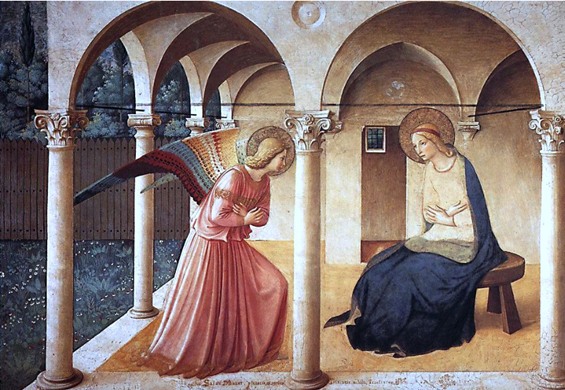
Guido di Pietro, better known as Fra Angelico, is also linked to the Vicchio area. Local sources say he was born in Rupecanina, a hamlet in the municipality.
In central Vicchio, the Museum of Sacred Art and Popular Religion of Fra Angelico preserves and showcases works from churches across Mugello. It tells the story not only of the artist it is named after, but also of the area’s religious and artistic heritage.
A visit to the museum fits easily into a stroll through Vicchio’s historic centre.
The Painters' Trail
One of the best ways to explore Vicchio’s connection with its artists is to follow the Painters’ Trails, a network of routes combining nature, history and culture.
The trails link Vicchio town centre with places associated with Giotto, Fra Angelico and Cimabue, passing through the countryside, small villages and rural landscapes. Stops along the way include Giotto’s House, places connected with Fra Angelico and Ragnaia Bridge over the Ensa stream, where local tradition places the famous meeting between Cimabue and the young Giotto.
It’s a lovely way to discover this corner of Mugello: more than a visit to a museum, it’s a journey through the landscapes that have shaped the area’s history and imagination.
There are several routes and variations, so we recommend checking the route and trail conditions before setting out.
A Stroll Through Vicchio’s Historic Centre
It’s worth setting aside some time to explore Vicchio’s historic centre.
The town is compact and easy to explore on foot. Piazza Giotto is at its heart, and its name reflects Vicchio’s connection with its most famous artist. We recommend stopping for an aperitivo at one of the cafés in the square, beneath Giotto’s statue.
From there, you can visit the Fra Angelico Museum and wander through the town’s streets before heading out into the surrounding countryside.
Vicchio is easy to visit without setting aside a whole day. It makes a lovely destination for a morning or afternoon, perhaps followed by lunch at a local trattoria.
A Half-Day Itinerary
For a visit to the main sights, a simple itinerary could be:
Vicchio → Fra Angelico Museum → Vespignano → Giotto’s House
Start with a walk through Vicchio’s historic centre and a visit to the Fra Angelico Museum, then make your way to Vespignano and Giotto’s House.
If you have more time, you can extend your visit with a walk along part of the Painters’ Trails or explore the surrounding countryside.
Useful info
Opening days and hours for Giotto’s House and the Fra Angelico Museum may vary throughout the year.
Before visiting, we recommend checking the latest information on the official Vicchio Town Council website or with the organisations that manage the sites.
For the Painters’ Trails, wear suitable walking shoes and check your chosen route in advance, especially after wet weather.
Discover Vicchio During Your Stay at La Casa nel Bosco
Set in the countryside near Vicchio, La Casa nel Bosco is within easy reach of both the town centre and the area’s main cultural attractions.
We’ll be happy to help you plan your visit, suggest places to see in the same day and recommend spots to eat or spend a few hours exploring the area.