Before Vicchio: Poggio Colla, Montesassi and the Ancient History of a Mugello Hillside

Today, the road from Ponte a Vicchio towards Montesassi winds through woodland, along narrow lanes and past small clusters of houses. It’s a quiet corner of Mugello, seemingly far removed from the great events of history.
And yet, within just a few kilometres are traces of a history spanning millennia: Poggio Colla, one of Mugello’s most important Etruscan archaeological sites; the ancient settlement of Montesassi, with its fortress and Church of San Giusto; the presence of the old and noble Florentine Adimari family; and Ponte di Montesassi, built in the late 13th century and closely linked to the founding of Vicchio.
We can’t claim with certainty that this was one continuous story. Many centuries separate the Etruscans of Poggio Colla from the medieval inhabitants of Montesassi, and evidence from the intervening period is fragmentary.
One feature does recur, however, and may help explain the long history of settlement on this small hill on the outskirts of Vicchio: its geography.
The hill overlooks the Sieve at a point where the valley narrows to form a natural passage between Mugello, Valdisieve and the Apennines. Clearly, in very different periods, this position retained strategic, economic and settlement importance.
Poggio Colla: The Etruscans in the Hills around Vicchio
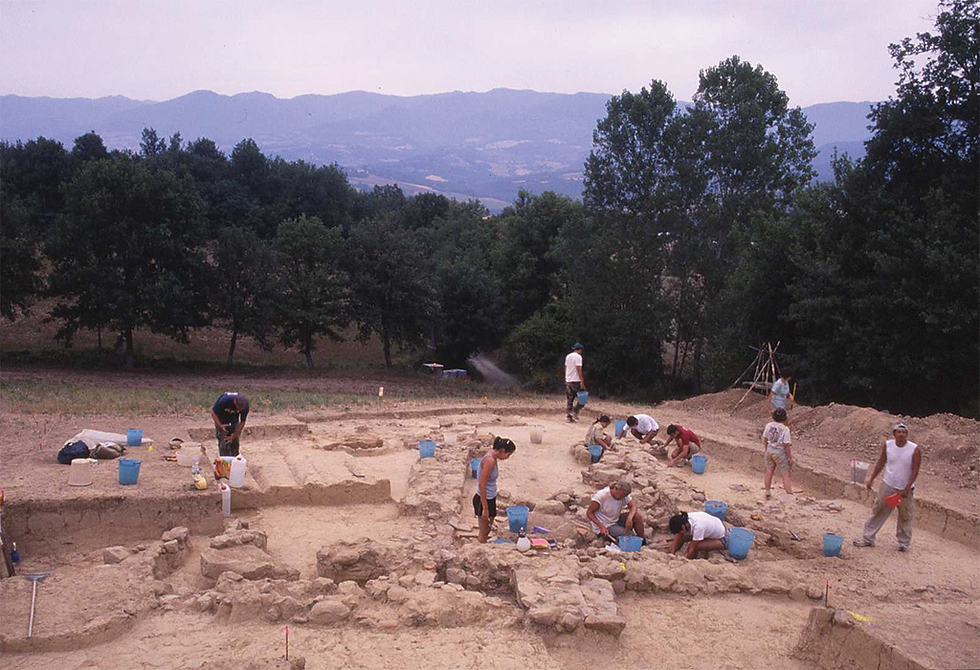
The earliest major evidence of the area’s history takes us back more than two thousand years.
A short distance from Montesassi lies Poggio Colla, one of Mugello’s most important Etruscan archaeological sites. Research has documented a settlement active from the 7th to the 2nd century BC, built around an important sanctuary on the hilltop.
The first excavations were carried out by Francesco Nicosia between 1968 and 1972. From 1995 to 2015, the site was systematically investigated by the Mugello Valley Archaeological Project, led by P. Gregory Warden and his colleagues.
The excavations showed that Poggio Colla was more than an isolated hilltop sanctuary. The surrounding landscape was much more complex, with homes, quarries and craft production. According to Warden, surveys suggest that the inhabited areas may have covered several square kilometres, including the nearby hills of Monte Sassi and La Romanesca. Archaeologists have identified a stone quarry on the slopes that was in use as early as the 7th century BC, as well as areas where pottery was made. Around 800 metres from the sanctuary, they also discovered a craft quarter with at least three kilns.
This is particularly significant for the history of Montesassi. It suggests that, in Etruscan times, activity was not confined to the summit of Poggio Colla but extended across a wider area of the surrounding hills.
The site was chosen for its strategic position. Poggio Colla overlooks the Mugello basin and the Sieve Valley, and would have offered control over important routes linking Etruria with the peoples of northern Italy. Warden notes that the Apennines may have served not only as a barrier but also as a corridor for contact and trade between Etruscans, Gauls, Ligurians and Veneti.
The site changed considerably over the centuries. Archaeologists have identified at least three major building phases at the sanctuary, preceded by an earlier phase. In its final period, Poggio Colla also took on the character of a fortified settlement. This last phase may have been destroyed during the Roman expansion into the area, probably around 188 BC.
The Vicchio Stele

The most remarkable discovery came in 2015, during the final season of excavations.
In the foundations of a temple built around 500–480 BC, archaeologists found a large sandstone block with an unusual shape. Once they cleaned its surface, they uncovered numerous Etruscan letters. The stone was actually a monumental stele, once used within the sanctuary and later repurposed as part of the temple’s foundations.
The stele is older than the building in which it was found. Warden dates it to at least the late 6th century BC, and analysis shows that it was inscribed and then reinscribed several times. The original text may have contained around two hundred characters, although part of the inscription has since been lost.
One of the legible inscriptions includes the names of Tinia and Uni, two of the principal Etruscan deities, confirming the monument’s religious significance.
Warden puts forward a particularly intriguing possibility: the stele may have served as a kind of lex sacra—a law or set of religious rules for the sanctuary. If confirmed, this would make it one of the earliest known examples of written religious law in Europe. For now, however, this remains a scholarly interpretation, as much of the Etruscan text is still difficult to translate.
A Sanctuary with Strong Female Associations

Excavations have also uncovered evidence of women’s presence and role in the sanctuary’s rituals, including gold jewellery, tools associated with textile production and distinctive types of pottery.
One of the most unusual finds is a fragment of bucchero pottery, dating from the 7th or 6th century BC. It depicts a small scene of a woman giving birth and, when published, was considered the oldest known representation of childbirth in Europe.
These discoveries have led archaeologists to suggest that women played an important part in the sanctuary’s ritual life.
We can’t claim there was a direct link between the Etruscan settlement and medieval Montesassi. It is significant, though, that this same stretch of hillside played an important role in transport routes and the organisation of the area in periods separated by many centuries.
Montesassi Before Vicchio
In the Middle Ages, the area’s centre of power and settlement looked very different from today.
Before Vicchio took on the role it has today, Montesassi was already an established settlement, centred on its hill, fortification and, later, the Church of San Giusto.
The Fortress of Montesassi formed part of the complex network of holdings belonging to the Guidi Counts, one of the leading feudal families of the Tuscan-Romagnol Apennines.
During the 13th century, however, relations between Mugello and Florence were changing profoundly. The city’s powerful families began expanding into the surrounding countryside, acquiring castles, land and feudal rights further and further from the city.
The Adimari were among these families. They were one of the great magnate houses of medieval Florence, influential enough to leave their mark on Dante’s Divine Comedy. In Canto XVI of Paradiso, Dante refers to them as “the presumptuous brood”, in a sharply critical passage. He also writes about individual members of the family, including Filippo Argenti and Tegghiaio Aldobrandi.
A study by historian Enrico Faini records that in 1245 the Adimari bought the castle of Montesassi from the Guidi. The archival reference is precise: State Archives of Florence, Diplomatic Collection, Strozziane Uguccioni, 16 September 1245. Faini places the acquisition within a broader pattern: members of Florence’s ruling class began acquiring castles and territories in the countryside, along with the feudal rights attached to them.
Montesassi was therefore more than a country residence. It was part of a much wider transformation in the relationship between Florence and its surrounding territory.
The Adimari, Montesassi and the Palagio
The Adimari family’s connection with the area seems to have continued beyond the 13th century.
An especially interesting record comes from the 15th century, in studies of Bonaccorso di Filippo Adimari, a copyist born in 1404.
Drawing on earlier archival research, scholar Alessandra Santoni explains that Bonaccorso’s family lived in the parish of San Giusto a Montesassi, in a house known as “il Palagio”, and drew income from local landholdings. The study describes Bonaccorso himself as living in Montesassi, even though he liked to sign his manuscripts “from Florence”.
This detail is valuable because it shows that, two centuries after the medieval acquisition of the castle, the Adimari name was still closely connected with Montesassi and with a residence known as the Palagio.
San Giusto a Montesassi: The Centre of a Community
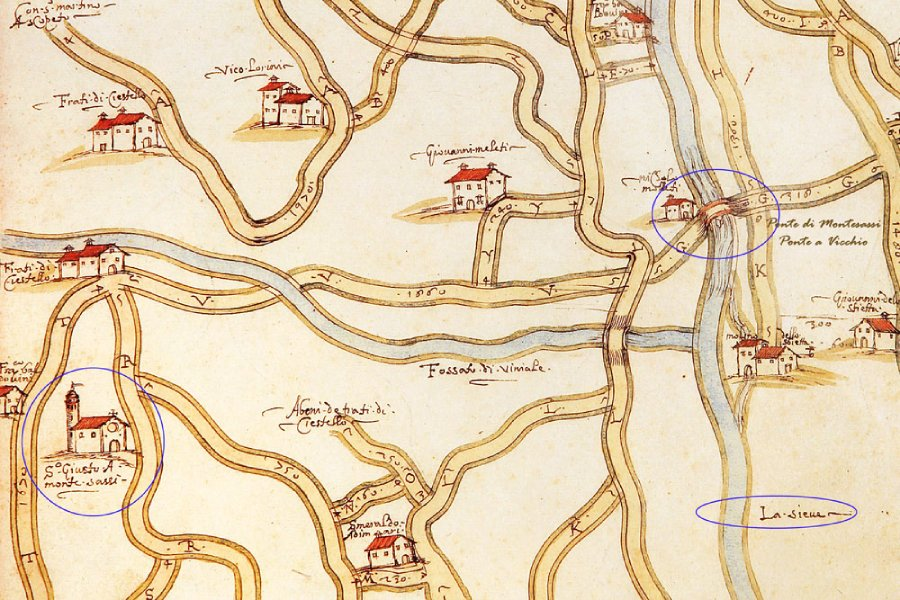
The history of this hill becomes clearer when we look at San Giusto a Montesassi.
The old church stood on a level terrace at an altitude of around 337 metres. According to an account published by Il Filo del Mugello, it belonged to the parish district of San Martino a Scopeto, also known as Viminiccio, and served a community where farming was made difficult by the steep slopes and rocky ground. People also worked in the woods and as stonecutters.
In 1515, the rector was Filippo Adimari, and the family still held the right of patronage over the church. The patronage later passed to the Morelli family.
An extraordinary picture of the area comes from its maps.
A map held at the State Archives of Florence, dated between 1580 and 1595, depicts the Popolo di San Giusto a Montesassi, or parish community of San Giusto at Montesassi. The church stands at the centre of an area criss-crossed by country lanes leading to houses and farms. At the end of the 16th century, around 150 people lived there.
By 1745, the population had risen to 233. On 22 September 1773, however, the Diocese of Florence decreed that San Giusto parish should be suppressed. Its property and income were later transferred to the parish of San Giovanni Battista in Vicchio. The church continued to be used occasionally for some time before gradually falling into disuse.
The old church also left an important artistic legacy.
The Fra Angelico Museum in Vicchio houses a Madonna and Child Enthroned with Saints Justus and Lawrence, a tempera-on-panel painting dating to the early decades of the 16th century. It originally stood above San Giusto’s high altar.
The Montesassi Bridge and the Transformation of the Valley
The turning point in the area’s history came at the end of the 13th century.
On 8 February 1295, Florence ordered the construction of a stone bridge across the Sieve, opposite Montesassi. This was the Ponte di Montesassi, now known as Ponte a Vicchio.
The historical records even preserve the names of the master builders: Gianni di Megliorotto da Vico and Nuto di Bruno da Fiesole. During construction, the central arch collapsed, leading to a dispute between the municipality and the stonecutters.
Once completed, however, the bridge had a far greater impact than the difficulties encountered during its construction.
It provided a much more direct link to the opposite bank of the Sieve and encouraged people from surrounding communities to move down into the valley. Il Filo explicitly connects this process with the people of Montesassi, who crossed the river and helped build the first homes in Vico, the settlement that would become Vicchio.
The bridge should also be seen in the context of Florence’s gradual political expansion into Mugello. Roads, river crossings and new fortified settlements were among the means by which the city extended its control over the surrounding countryside.
In the centuries that followed, the bridge remained a landmark not only for travel but also for religious life in the area. At its entrance stood the Oratory of Madonna della Neve, a chapel documented from at least the early 18th century. A land survey from 1708 refers to it as “the chapel at the Bridge of Vicchio”.
The chapel housed a fresco of the Madonna and Child, already thought in the early 20th century to date from the 15th century.

IThe connection with Montesassi’s history is particularly interesting. In the 18th century, the Morelli family, who had succeeded the Adimari, held patronage rights over both the oratory and the Church of San Giusto a Montesassi above it. The chapel is further evidence that the bridge had become a small hub, surrounded by homes, local activity and places of worship.
The area suffered greatly during the Second World War. In 1944, retreating German forces blew up the medieval bridge, which was later rebuilt. The oratory, however, disappeared for good soon afterwards. According to Il Filo, it is unclear whether the explosion had badly damaged it or whether it obstructed the passage of military vehicles. The complex was later demolished on the orders of the British command.
From Montesassi to Vicchio
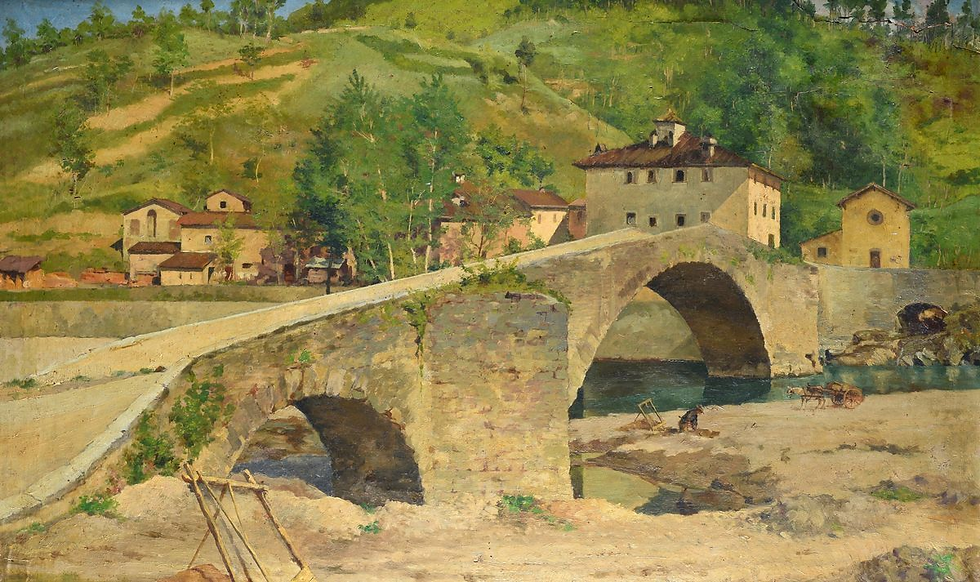
Vicchio did not emerge in an uninhabited landscape. Its origins lie in the gradual reorganisation of an area already home to communities scattered across the hills.
Montesassi, San Giusto and other small settlements continued to exist, but the new river crossing gradually shifted the centre of local life towards the valley floor.
This becomes especially clear when you look out over the area from Montesassi.
The geographical connection is easy to see: the hill, the Sieve, Ponte a Vicchio and, further on, Vicchio itself are all part of the same landscape.
In this sense, Montesassi is more than an outlying place near Vicchio: it is part of the story of the town’s origins.
A Landscape of Farmers, Woodcutters and Stonecutters
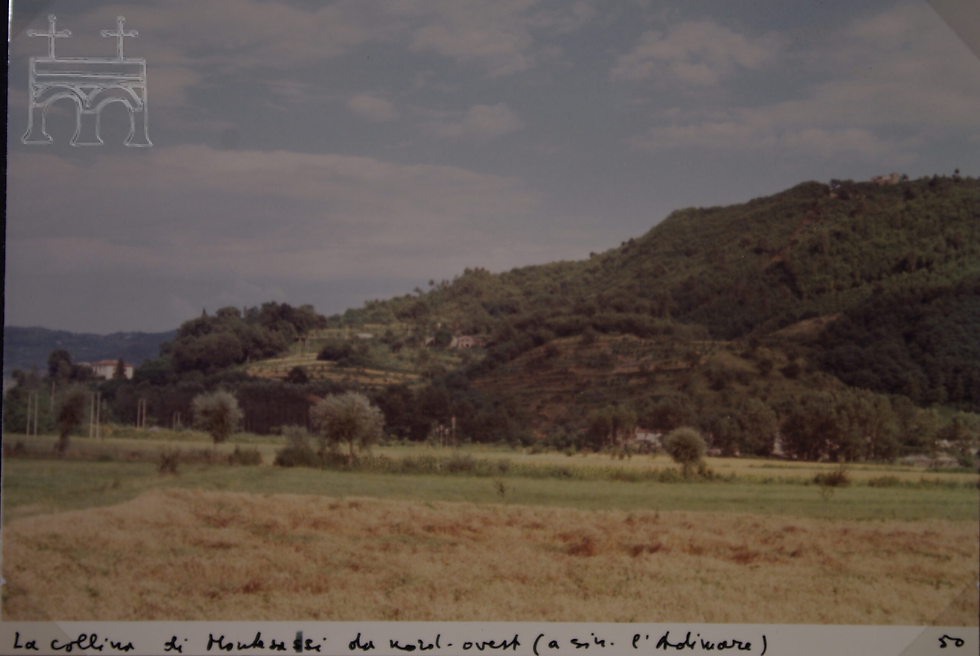
For many centuries, Vicchio’s growth did not lead to the abandonment of the hill.
Montesassi remained a landscape of farms, farmhouses, fields and heavily used woodland.
The terrain made farming difficult and encouraged other kinds of work. Local sources mention woodcutters and stonecutters in particular, the latter making use of the area’s abundant sandstone.
Until the early 20th century, the landscape would have been much more open and more densely populated than it is today.
Photographs taken by Elio Conti between 1968 and 1970 capture this transformation. His archive includes panoramic views of Montesassi hill and Ponte a Vicchio, abandoned farmhouses and roads now completely overgrown. The photographs can be viewed here.
These images are especially valuable because they document the area as sharecropping and traditional farming were coming to an end. The Elio Conti Archive was established specifically to document these changes in the rural landscape around Florence.
The 1919 Mugello Earthquake
Another turning point came with the major earthquake of 29 June 1919.
The earthquake severely affected this part of Mugello. The INGV Macroseismic Database lists both Montesassi and Villa Adimari among the places that suffered damage.
The accounts written shortly after the earthquake by Francesco Niccolai are particularly valuable.
As he travelled through these hills, Niccolai described the condition of the farmhouses in Montesassi, Pimaggiore, San Biagio and Romanesca, the damage to the Chapel of San Giusto, and the stonecutters working the sandstone for reconstruction.
His account also mentions the Fonte degli Adimari and an ancient villa in the area, which Niccolai dated to the 13th century and attributed to Smeraldo Adimari. The earthquake had severely damaged it.
Some of Niccolai’s archaeological interpretations naturally reflect the knowledge of his time and should be treated with caution today. His account remains an extraordinary source for reconstructing the landscape and buildings of Montesassi in the early 20th century.
The Return of the Woodland
Over the course of the 20th century, this world changed rapidly. The gradual decline of sharecropping, the abandonment of many farms and the movement of people to larger towns all contributed to a reduction in cultivated land.
Woodland reclaimed fields, pastures and areas that had been farmed for centuries.
What may now look like a natural landscape untouched for centuries is, at least in part, the result of relatively recent changes.
One Hill, Many Stories
Poggio Colla, Montesassi, San Giusto, the fortress, Villa Adimari and Ponte a Vicchio belong to very different periods, but they are all part of the same small area.
The oldest traces date back to the Etruscan settlement at Poggio Colla. In the Middle Ages, the hill’s history was shaped by the fortress, the Adimari family and the community centred around San Giusto. Later, the construction of Ponte di Montesassi gradually shifted the centre of activity towards the valley floor, helping Vicchio to grow.
The area continued to change in the centuries that followed. The 1919 earthquake left deep marks on its buildings and landscape. Photographs from the 20th century show countryside that was still far more open and populated than it is today, before rural depopulation and the return of the woodland.
More than two thousand years of history are concentrated within just a few kilometres. That may be what makes Montesassi so fascinating: beneath the quiet appearance of today’s hillside, traces of very different worlds can still be read side by side.
Sources and Further Reading
Poggio Colla and the Vicchio Stele – Superintendency of Archaeology, Fine Arts and Landscape. The leading institutional source on the site’s history, excavations, strategic location and Etruscan stele. Signs in Stone – The Stele of Poggio Colla
Enrico Faini, The Florentine Ruling Class in the Age of the Consuls. Published in Archivio Storico Italiano, this study documents the Adimari family’s purchase of Montesassi Castle in 1245 and refers to the deed dated 16 September. Read Enrico Faini’s study
Alessandra Santoni, Bonaccorso di Filippo Adimari: A Passionate Copyist from the Countryside. This academic source, used here for the family’s presence in the parish of San Giusto in the 15th century and for the house known as the Palagio. Public profile of Alessandra Santoni’s work
Massimo Certini, “San Giusto at Montesassi: The Church That No Longer Exists”, Il Filo del Mugello. A rich source on San Giusto, Ponte di Montesassi, Filippo Adimari, 16th-century maps, population and the suppression of the church. Read the article in Il Filo del Mugello
Francesco Niccolai and the 1919 earthquake. Radio Mugello has republished Niccolai’s original accounts, with many direct references to Montesassi, San Giusto, Fonte degli Adimari and the villas in the area. Francesco Niccolai’s accounts of the 1919 Mugello earthquake
INGV – Italian Macroseismic Database. Useful for confirming that Montesassi and Villa Adimari were among the places affected by the earthquake of 29 June 1919. The Mugello earthquake of 29 June 1919 – INGV
Elio Conti Photographic Archive. Holds a fascinating collection on Montesassi and Adimare, including MSS0027, Villa and Houses above Adimare, 16 May 1970; MSS0028, Montesassi Hill from the North-West (Adimare on the Left), 1968; and MSS0030, Ponte a Vicchio and Montesassi, 1968. Villa and Houses above Adimare – 1970 · Montesassi and Adimare – 1968 · Ponte a Vicchio and Montesassi – 1968
P. Gregory Warden, “An Etruscan Stone Speaks”, Expedition Magazine, Penn Museum, 2023. Particularly useful because Warden co-directed the Mugello Valley Archaeological Project and writes about the excavation findings and interpretations.
Adriano Gasparrini, “The Oratory of Madonna della Neve at Ponte a Vicchio: A Brief History of a Lost Chapel”, Il Filo del Mugello. Useful for the bridge’s later history, the Morelli family’s patronage and the oratory’s demolition in 1944. Read the article in Il Filo



Comments